
Web, app and product build
One team builds the whole thing.
Design, interface, logic and the parts nobody sees. Twenty years of running every one of those roles, brought to your project for exactly as long as it needs them.
The shorter route
Five hires, or one team
One good product needs five distinct skills. Each person does something the others cannot, and most of them have little to do once it ships.
- A designerVisual language, layout, the thing people judge in four seconds
- A UX personHow it actually works, where people get stuck
- A front-end developerTurning the design into something that behaves on every screen
- A back-end developerData, integrations, the parts nobody sees until they break
- A project manager or QAKeeping the other four pointed the same way
or
One team, for the length of the project
We have run these roles for two decades, so we bring the ones your project needs and leave out the ones it does not. You get a single point of contact rather than five calendars.
- No permanent headcount for temporary work
- No recruiting cycle before anything starts
- No handover gaps between design and build
- Scaled to the project, not to a staffing plan
2026
Why one team can now do what five used to
This is not a claim about being clever. The work genuinely changed shape in the last two years, and the maths above only holds because of it.
AI took over the mechanical half
- Boilerplate code and scaffolding
- First-draft layouts and component variations
- Test coverage and documentation
- Content drafts, in volume, in any tone
- Migrations and repetitive refactors
A person still decides
- What is actually worth building
- Which trade-off matters when two things conflict
- That the brief is wrong, before three weeks go into it
- What a buyer will believe and what they will not
- When to say no to a feature somebody wants
The constraint was never typing speed. It is judgement about what to build, and that is the half twenty years actually buys you.
The stack
Four layers, one team across all of them
Most projects need work at every level. Splitting them between suppliers is where things get lost, because each one optimises their own layer and nobody owns how they meet.
Interface
What people actually touch, on every screen size they own.
React, Next.js, Vue, HTML and CSS
Content
So your team can change things without raising a ticket.
WordPress, Divi, WooCommerce, headless CMS
Application
Accounts, payments, integrations, and the rules that make it yours.
PHP, Node, Python, REST and GraphQL APIs
Infrastructure
The part you should never have to think about again.
Hosting, CDN, SSL, backups, monitoring
What gets built
From a landing page to a platform
01 / Websites
Websites that sell
A clear argument and an easy next step. Built to convert, not to win awards.
02 / Applications
Web applications
Dashboards, portals, booking and accounts, where the interface is the product.
03 / Mobile
Mobile apps
When a phone genuinely changes what the product can do for someone.
04 / Commerce
Ecommerce
WooCommerce and Magento, including catalogue, checkout and what happens after the order.
05 / Rebuilds
Rebuilds
Something exists and is holding you back. More common than anyone admits.
06 / Systems
Design systems
So page five and page fifty still look like the same company without us.
07 / AI workflows
AI workflows and integrations
The newest half of this job, and increasingly the reason people call. Agents that read an inbox and act on it, assistants trained on your own documents, classification and routing that used to need a person, and language models wired into the parts of your product that benefit from them.
Built into what you already run rather than bolted alongside it, and built so you can see what it did and why.
Where we stand
What we would build with in 2026
Most agencies will use whatever you ask for. We have opinions, and you should know them before you hire us rather than halfway through. Worth disagreeing with us now if you do.
| Technology or approach | Our position | Why |
|---|---|---|
| Meta-frameworks | Adopt | Next.js when the thing holds state, Astro when it is mostly content. The default for anything new. |
| One well-structured codebase | Adopt | Split it into services only when something specific forces you to, not because it sounds mature. |
| AI across the mechanical work | Adopt | With a person signing off every new dependency it introduces. Unreviewed packages are how supply chains break. |
| Responsiveness over load time | Adopt | Whether a tap responds now matters more to a buyer than shaving tenths off the first paint. |
| Structure for answer engines | Adopt | Being readable by AI assistants is now a build decision, not something bolted on afterwards. |
| Fully autonomous coding agents | Watch | Useful as a reviewer that flags risky changes. Not yet something we let write across a codebase unsupervised. |
| Edge rendering | Watch | Genuinely good for read-heavy pages and personalisation. We keep anything transactional off it. |
| Microservices by default | Skip | Pure overhead for almost every project we see. Earn the complexity before you take it on. |
| Rebuilding as a single-page app | Skip | Without a rendering strategy you trade search visibility for a smoothness nobody asked for. |
| Voice search optimisation | Skip | It was sold hard for a decade and never arrived. The budget belongs on how AI assistants read your pages instead. |
Proof, not adjectives
A fintech platform, reimagined end to end
US fintech, twelve month engagement
Online Check Writer had serious software behind an interface that was not doing it justice. For a payments company the first job of a website is to establish that you can be trusted with money, and theirs was working against that: no hierarchy, and nothing on the page explaining what the product actually did.
- Rebuilt the identity from the ground up, then redesigned the entire web application around it
- Produced the creative collateral and ran the social presence alongside the build
- The company went on to raise through Y Combinator and was later acquired by Zil Money
Their software earned the acquisition, not our design. What the work changed was whether people took it seriously long enough to look.
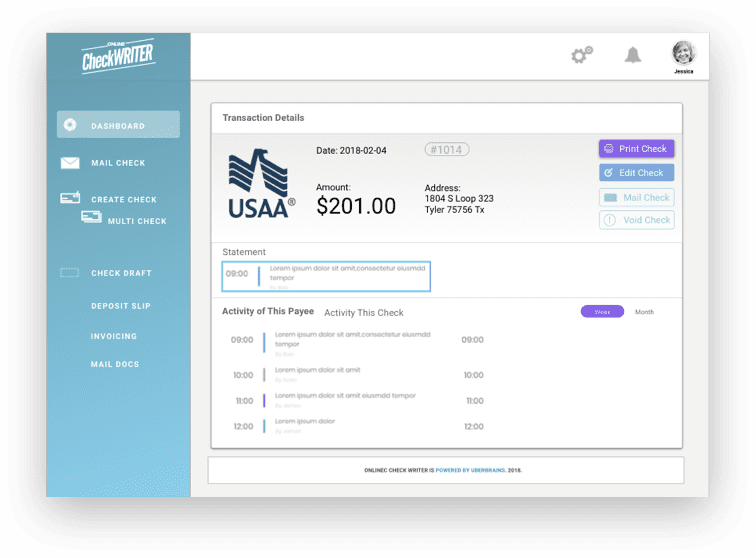
A snapshot from the rebuilt web application interface.
How it runs
Four stages, and you see work at the end of each
Work out what it is for
Who it is for and what it has to make happen. Usually shortens the build.
Structure before surface
How it is organised and how someone moves through it, agreed before anything looks finished.
Design and build together
Not design, approval, then a developer reinterpreting it. That gap is where projects lose their shape.
Hand over properly
You can edit it without us. Come back because you want more, not because you are locked in.
Start with the problem, not the brief
Tell us what you are trying to build
Even roughly. What it needs to do, who it is for, and what is wrong with whatever you have now. We will tell you what it would take, whether we are the right people for it, and what it would cost before anybody commits to anything.
If you are not sure the build is the problem, our marketing diagnosis tool is free and takes about thirty seconds. Sometimes the site is fine and something else is broken.
Questions we get asked
Before you send a brief
How much does custom web design and development cost?
It is quoted per project, because the honest answer depends on what the thing has to do. A marketing site with six pages and a web application with user accounts, payments and an admin panel are not the same job, and a fixed price list would only be right for one of them.
What we can tell you early is the shape. After one conversation about what it needs to do, we will give you a range and what moves it up or down, before you spend anything. If the range does not work, that is a useful thing to find out in week one rather than week six.
Do you have an in-house team for web and mobile development?
Design, user experience, front-end and project direction are in house, and that core team is the same on every project.
Specialist work such as a particular backend stack, a native mobile build or a heavy integration comes from people we have worked with repeatedly over years. We would rather say that plainly than claim a forty person studio. Most agencies our size work exactly this way, including the ones that do not mention it.
Why use an agency instead of hiring a development team?
Because a build is temporary and a salary is not. Putting out one good product needs a designer, a UX person, a front-end developer, a back-end developer and someone keeping them aligned. That is five hires, a recruiting cycle before anything starts, and four roles with little to do once it ships.
Hiring makes sense when you are building a product continuously and the work never stops. For a project with an end, you are paying permanent cost for temporary need.
Can AI just build my website now?
It can build you something that works, quickly, and for a simple site that may be all you need. We use the same tools daily and would not pretend otherwise.
What it will not do is tell you that the thing you asked for is the wrong thing. It takes your brief at face value, including the parts that are wrong, and produces a confident version of them. Most failed projects we are called in to rescue failed at the brief, not at the code.
There is also a 2026 wrinkle worth knowing. Pages now have to be readable by AI answer engines as well as by Google, which changes how content is structured and marked up. A generated site will rarely do that on purpose.
How long does a website or application take to build?
A marketing site is usually a few weeks. An application is months, and the range is wide enough that any number quoted before scoping would be made up.
The thing that moves timelines most is not our speed, it is how quickly decisions come back and whether the content exists. Projects that run late almost always run late for those two reasons.
Will I be able to edit the site myself afterwards?
Yes, and we treat that as part of the job rather than an extra. You get a site you can change without needing us for a headline or a new page.
Where we build something genuinely custom, you get documentation for it. If you come back to us afterwards it should be because you want more built, not because nobody else can touch it.
Our Clients


+ Few Solopreneurs & Startups doing cool stuff in Food, Lifestyle, & Technology.
Some of them are providing hyperlocal services while some aiming the world. Some are close to securing their funding.
Digital Marketing from Experienced & Certified Professionals


